
Mitsubishi EVO X vs Subaru WRX STi
Evo X vs WRX STI: Which rally legend wins? Compare performance, handling & more.
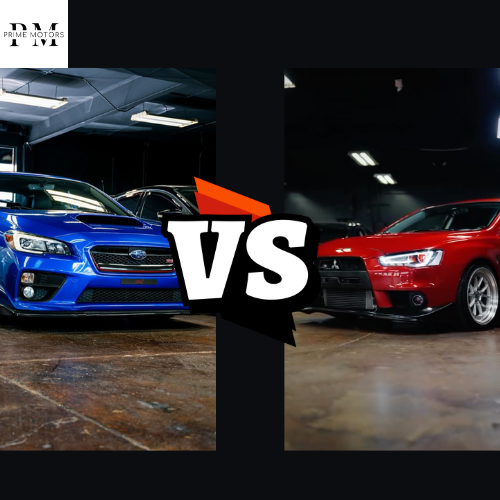
Mitsubishi Evo X vs Subaru WRX STI: The Ultimate Rally Legend Showdown
For performance car enthusiasts in Portland and beyond, few rivalries spark as much passion as the battle between the Mitsubishi Lancer Evolution X and the Subaru WRX STI. These Japanese rally-bred icons have been going head-to-head for decades, each offering blistering performance, all-wheel-drive mastery, and that unmistakable turbocharged thrill that keeps drivers coming back for more.
At Prime Motor Co., we've had the privilege of working with both of these legendary machines, and we understand what makes each one special. Whether you're searching for razor-sharp handling dynamics or a more engaging driving experience, this comprehensive comparison will help you decide which rally legend deserves a spot in your garage.
Performance Under the Hood: Power Delivery Philosophy
Mitsubishi Evo X: Precision Meets Punch
The Evo X arrived with an all-new aluminum 4B11T 2.0-liter turbocharged inline-four engine, marking a significant departure from its cast-iron predecessors. In its base form, the Evolution X GSR produces 291-295 horsepower and 300-366 lb-ft of torque, though higher-spec FQ models pushed well beyond 400 horsepower.
What sets the Evo apart is its power delivery character. The 2.0-liter turbo feels more refined and linear compared to previous generations, with smooth, accessible power throughout the rev range. The engine's aluminum construction saves approximately 12 kilograms of weight while utilizing MIVEC variable valve timing on both intake and exhaust valves. The result is an engine that builds boost earlier and maintains it more consistently, creating that signature point-and-shoot driving experience the Evolution is famous for.
Subaru WRX STI: Raw, Mechanical Character
The WRX STI counters with its iconic EJ257 2.5-liter turbocharged boxer engine, delivering 305-310 horsepower (depending on model year) and approximately 290-407 Nm of torque. The larger displacement gives the STI a different personality—one that's more old-school and characterful.
However, the STI's power delivery has its quirks. Below 3,000 rpm, the engine feels sluggish, almost lazy. But once the turbo spools up, it delivers power in one massive, intoxicating surge. This creates a more dramatic, visceral experience, though it requires keeping the engine in its sweet spot and making frequent gear changes. The short gearing means you'll be shifting constantly, but for enthusiasts who love rowing through gears, that's part of the appeal.
The trade-off? The EJ257 is an aging design with well-documented reliability concerns, particularly ringland failures that can occur even at stock power levels. The 4B11T in the Evo X, being chain-driven rather than belt-driven, proves less prone to catastrophic failure.
All-Wheel Drive Systems: Two Different Philosophies
Evo X's S-AWC: Computer-Aided Precision
The Evolution X features Mitsubishi's advanced Super All-Wheel Control (S-AWC) system, which integrates Active Center Differential (ACD), Active Yaw Control (AYC), Active Stability Control (ASC), and Sport ABS. The system is highly sophisticated, using torque vectoring to actively brake individual wheels and shuffle power to wherever it's needed most.
The AYC rear differential is particularly impressive—it can actively accelerate the outside rear wheel in corners, rotating the car faster and allowing for earlier throttle application. This creates an almost supernatural feeling of being guided through corners, with the car seemingly reading your mind. However, some purists feel this electronic intervention takes away from the raw driving experience.
The S-AWC system offers three modes: tarmac, gravel, and snow, allowing you to tailor the all-wheel-drive response to different surfaces.
STI's Symmetrical AWD: Mechanical Mastery
The STI takes a more mechanical approach with its Symmetrical All-Wheel Drive system, featuring three differentials: a driver-controlled center differential capable of sending up to 80% of torque to either axle, a helical front differential for torque management and vectoring, and a Torsen limited-slip rear differential.
What makes the STI special is its adjustability. The driver-controlled center differential allows manual biasing of torque distribution front-to-rear. Lock it to the rear, and you can smoke the rear tires in a proper four-wheel drift. This gives the STI a more natural, engaging feel—like you're working with the car rather than being managed by it.
The STI's system feels more stable and predictable, with the constant mechanical grip inspiring confidence even at high speeds. It's less aggressive than the Evo's electronic wizardry but offers incredible traction and that satisfying mechanical connection that enthusiast drivers crave.
Handling and Driving Dynamics: Track vs Street
On the Track: Evo X Takes the Crown
When it comes to outright lap times and corner speed, the Evo X consistently edges out the STI. The Mitsubishi feels sharper, more agile, and more willing to change direction quickly. Turn-in is crisper, steering feedback is more communicative throughout the range, and the torque vectoring allows you to attack corners harder.
The Evo's approach is clinical precision—brake late, turn in sharply, point the car at the apex, and let the electronics sort everything out while you hammer the throttle. It's faster around a circuit, no question, and the sophisticated S-AWC system allows less experienced drivers to achieve impressive lap times.
Daily Driving: STI Wins on Engagement
For street driving, the STI offers a more rewarding, tactile experience. The steering is heavier and provides excellent feedback. The six-speed manual transmission is widely praised as one of the best in the business—short-throw, precise, with a light and progressive clutch pedal. In comparison, the Evo X's five-speed manual feels clunky, and the clutch requires more finesse to drive smoothly.
The STI feels more organic, more connected to the driver. It's the car that flatters your driving skill rather than masking your mistakes. There's something deeply satisfying about the mechanical nature of the STI—the way the drivetrain responds, the weight of the controls, the connection between driver and machine.
However, the Evo's superior handling comes at a cost. Its brakes resist fade longer on track, and its sharper dynamics mean it can be more challenging to drive at the limit.
Interior Quality and Daily Livability
Evo X: Functional but Dated
The Evo X marked a significant step forward in interior quality for Mitsubishi. The cabin features improved plastics over previous generations, Recaro sport seats with excellent bolstering, a leather-wrapped steering wheel, aluminum pedals, and a multi-information display. European-influenced design makes it feel more grown-up than its predecessors.
That said, the interior still can't match European standards, and the materials, while improved, feel basic for a car approaching $40,000+ when new. The MR trim added extra sound insulation and premium features like navigation and upgraded audio, but even then, it's clear the focus was on performance over luxury.
The five-speed manual (six-speed in SST models) means high revs and more engine noise at highway speeds, which can become tiring on long drives.
WRX STI: Rough Around the Edges
The STI's interior is arguably worse. It's characterized by copious amounts of hard plastic, creating an atmosphere that feels cheap for a vehicle in its price bracket. The design is dated, based on the older Impreza platform rather than the updated version. Road noise is prominent, and the overall ambiance isn't inviting for extended periods.
On the plus side, the STI offers practical rear seat space (better than the Golf R or Focus RS for knee room), a 460-liter trunk with 60/40 split-folding rear seats, and multiple storage cubbies. It's genuinely usable as a family car or daily driver, with surprising versatility for hauling gear.
Optional features include a 7-inch touchscreen (though it looks dated), navigation, Harman Kardon audio, blind-spot monitoring, and adaptive cruise control. The Recaro seats in both cars provide excellent support during spirited driving.
Fuel Economy and Running Costs
Neither car will win economy awards, but there's a noticeable difference:
- Evo X: EPA-rated at 17 city / 22-23 highway MPG. Real-world figures can dip lower with spirited driving.
- WRX STI: Even worse, managing around 17-19 combined MPG. Highway cruising might yield 23-26 MPG if you're gentle, but city driving hovers around 18-20 MPG.
The STI's shorter range is a real issue—with its 15.9-gallon tank, you're looking at approximately 350 miles maximum on the highway. The WRX (non-STI) achieves much better economy at 25+ MPG average, which is why many choose it as the more practical daily driver.
Modification Potential: Tuner's Paradise
Both vehicles are darlings of the aftermarket world, but they differ in approach.
Evo X: Easy Power Gains
The Evo X is exceptionally tuner-friendly. With just basic bolt-ons (intake, exhaust, boost controller) and an ECU reflash, you can easily achieve 300-320 wheel horsepower—a gain of 80-100 hp over stock. The 4B11T responds beautifully to modifications, and the factory ECU can be reflashed to accommodate extensive changes.
Stage 1 modifications typically include a 3-port boost solenoid, upgraded air filter, and tune, pushing output to around 330 horsepower. The aluminum block handles increased boost well, and the chain-driven design is inherently more robust. However, the SST dual-clutch transmission has a definite horsepower limit that shouldn't be exceeded.
Common upgrades include turbo-back exhaust systems, intercooler upgrades, fuel pump kits, and eventually turbo replacements for those chasing serious power. With proper tuning, the Evo X can make big power relatively safely.
WRX STI: High Risk, High Reward
The STI offers similar modification potential, but the EJ257 engine requires more care. The platform can handle over 500 wheel horsepower when properly built, and the VA-generation STI (2015+) is known for reliability at higher power levels.
However, the EJ257's reputation for ringland failure means modifications must be done carefully with proper tuning. Many used STIs on the market have had engine replacements due to these failures. The six-speed transmission is more durable than the Evo's five-speed and can handle abuse better.
If you're buying either car used, stock or near-stock examples are strongly recommended. Modified examples often have been poorly tuned or abused, leading to expensive repairs down the road.
Reliability and Common Issues
Evo X Known Problems
Common issues to watch for when buying a used Evo X include:
- AYC pump failure (common to all Evos; check for "Service Required" warning light)
- Cracked exhaust manifold/turbo hot side (especially on higher-mileage examples)
- SST transmission cooler brittleness (on dual-clutch models)
- Timing chain issues (early 2008-2010 models)
- Plastic clutch master cylinder leaks (manual transmission models)
- Front damper bearing wear (causes knocking from front suspension)
- Oil leaks from timing chain covers and sump seals
- Rust on undercarriage components (particularly in areas with road salt)
WRX STI Problem Areas
The STI has its own list of concerns:
- Head gasket failures (especially older models)
- Piston ringland failures (can occur even at stock power; look for low compression, smoke, poor idle)
- Rod bearing failures (often from aggressive driving or poor maintenance)
- Turbocharger failures (high-mileage or heavily-used examples)
- Oil leaks from valve covers, oil pan, and main seals
- Steering rack leaks
- Rear wheel bearing failures (older WRXs and 2004 STIs)
- Weak five-speed transmission (reverse feels particularly notchy)
- Rear fender arch rust (in areas with road salt—can rust completely through)
Both cars require diligent maintenance. Proper oil changes with quality oil, allowing the engine to warm up before hard driving, and avoiding modifications without proper tuning are essential for longevity.
Pricing in Today's Market
As of late 2024 and early 2025, here's what you can expect to pay:
Mitsubishi Evo X
- 2015 Final Edition (low mileage): $28,000-$35,000
- 2010-2014 MR models: $14,000-$33,000
- 2008-2010 GSR models: $17,000-$28,000
The Final Edition models command premium prices due to their collectibility and upgraded specifications (226 kW, 414 Nm).
Subaru WRX STI
- 2021 models (low mileage): $28,000-$33,000
- 2018-2020 models: $22,000-$32,000
- 2015-2017 models: $20,000-$28,000
STIs have remained relatively affordable, though low-mileage, unmodified examples command premium prices.
At Prime Motor Co., we regularly source both Evos and STIs for our discerning Portland clientele. We recommend setting aside additional budget for potential repairs and maintenance when buying either vehicle, especially if purchasing a high-mileage example.
Which Should You Choose?
Choose the Mitsubishi Evo X if:
✓ You prioritize outright speed and lap times
✓ You want sharper, more precise handling
✓ You prefer advanced electronics that flatter your driving
✓ You value modification potential with easy power gains
✓ You want the more reliable engine platform (4B11T vs EJ257)
✓ You're looking for something increasingly rare and collectible
Choose the Subaru WRX STI if:
✓ You want the most engaging driving experience
✓ You prefer mechanical feel over electronic intervention
✓ You value the best manual transmission in the segment
✓ You need better daily driver practicality and versatility
✓ You want easier parts availability and service network
✓ You appreciate Subaru's symmetrical AWD legacy
The Verdict: Two Legends, Different Strengths
There's no definitive "winner" in this rivalry—both cars excel in different areas. The Evo X is the faster, sharper track weapon with more sophisticated technology and easier power gains. It's the car that will post better lap times and impress with its clinical precision.
The WRX STI is the more engaging, rewarding driver's car with better daily usability and that intangible mechanical connection that makes every drive memorable. It's the car that puts a smile on your face even at legal speeds.
Both represent the pinnacle of rally-bred performance, and both have earned their place in automotive history. The Evo X, as the last of its lineage, carries added collectibility and appreciation potential. The STI continues Subaru's performance legacy with new generations still in development.
Experience Rally Legends at Prime Motor Co.
At Prime Motor Co. in Portland, Oregon, we specialize in high-performance vehicles from prestigious manufacturers, including both the Mitsubishi Lancer Evolution and Subaru WRX STI. As enthusiasts ourselves, we understand what makes these rally legends special, and we're committed to helping you find the perfect performance car for your needs.
Why Choose Prime Motor Co.?
✓ Carefully Curated Inventory – Every vehicle undergoes thorough inspection before joining our showroom
✓ Flexible Financing Options – Tailored solutions to fit your budget, regardless of credit situation
✓ Fair Trade-In Values – Get top dollar for your current vehicle
✓ Comprehensive Warranty Coverage – Drive with confidence knowing you're protected
✓ Expert Knowledge – Our team lives and breathes performance cars
Whether you're drawn to the Evo's technological sophistication or the STI's raw mechanical character, we invite you to experience these legendary machines firsthand. Visit us at 2627 SE Holgate Ave, Portland, OR 97202, call (971) 512-0578, or explore our inventory at www.primemotorco.com.
Ready to Own a Piece of Rally History?
Both the Mitsubishi Evo X and Subaru WRX STI represent more than just transportation—they're expressions of driving passion, engineering excellence, and motorsport heritage. With proper care and maintenance, either can deliver years of exhilarating performance and driving enjoyment.
Schedule your test drive today and discover which rally legend speaks to your enthusiast soul. At Prime Motor Co., we're here to make your performance car dreams a reality with transparent service, expert guidance, and a genuine love for these incredible machines.
Don't miss your chance to own one of these iconic turbocharged all-wheel-drive legends. Contact Prime Motor Co. now and let us help you find the perfect rally-bred performance car for your garage.
Prime Motor Co. - #1 Sports & Luxury Cars in Portland, OR | Trusted by 400+ customers with 4.7-star reviews | Your premier destination for high-performance vehicles including BMW M, Mercedes AMG, Audi RS, Subaru STI, and Mitsubishi Evo.